Many people are using milk substitutes as a "healthy alternative" to dairy.
Some of you might even be thinking "what's wrong with dairy now?" In my opinion, dairy milk is not necessarily bad- ideally, if we could drink it in its raw form it might even be beneficial, but since our laws don't allow it in most states, we have to do with pasteurized milk, which depletes a lot of the necessary enzymes in milk that help digest its proteins. This leads to many more people being intolerant or sensitive to dairy.
So if you are... you're probably drinking coconut, rice, soy, almond or hemp milk. (And there's an array of options out there!)
Better for you, right? According to a new report – WRONG!
Before I get into it, if you’re drinking any sort of milk substitute, go grab it and look for this ingredient: Carrageenan.
What Is Carrageenan?
Carrageenan is a common ingredient in the majority of milk substitutes, baby formulas, cottage cheese, and even some flavored coconut waters! It’s used as a stabilizer and/or emulsifier.
There are 2 “classes” of Carrageenan: "food safe" and approved and "non-food-safe" or non-approved.
The Research Studies and Its Findings
There has been plenty of published, peer-reviews literature in the scientific community for decades showing that non-food-safe carrageenan is inflammatory and carcinogenic in lab animals. In fact, non-food safe carrageenan was listed as a “possible human carcinogen” by the World Health Organization’s International Agency for Research on Cancer in 1983.
While it is well established that non-food-safe carrageenan is harmful, there have also been concerns with food-grade carrageenan dating back to the late 1970s! In fact, there are studies (including industry-funded studies) showing food-grade carrageenan is also linked to colon inflammation and colon cancer in animals. What?!?!
Additionally, some studies are reporting that “food-grade” carrageenan can degrade in the gastrointestinal tract to the same molecular weight/structure as non-food-grade carrageenan.
Lastly and sadly... it doesn’t matter whether the product is organic or not (Carrageenan was approved for use in organics in 1995 and re-approved in 2008). !@#$%???
Over the years a prominent researcher in the field, Joanne K. Tobacman, M.D., now associate professor of clinical medicine at the University of Illinois College of Medicine has published 18 peer-reviewed studies that address the biological effects of carrageenan and is convinced that it is harmful to human health. In April 2012, she addressed the National Organic Standards Board on this issue and urged reconsideration of the use of carrageenan in organic foods.
In her presentation, Dr. Tobacman said that her research has shown that exposure to carrageenan causes inflammation and that when we consume processed foods containing it, we ingest enough to cause inflammation in our bodies. She explained that all forms of carrageenan are capable of causing inflammation. This is bad news. We know that chronic inflammation is a root cause of many serious diseases including heart disease, Alzheimer's and Parkinson's diseases, and cancer.
So, What is One to Do?
It just seems like there is too much controversy around carrageenan, and too much risk that it could cause colon inflammation and colon cancer, so I am steering clear of carrageenan.
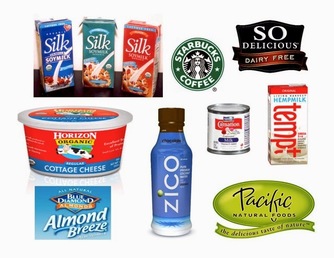
Check out these major brands that use Carrageenan:
Blue Diamond
Carnation
Horizon
Pacific
Silk (Silk Unsweetened Almond Milk does not have it)
So Delicious
Starbucks
Tempt
Zico
Read your ingredients list closely and stay away from carrageenan. Also, here is a handy list of brands that don't use carrageenan for different products.
Some of you might even be thinking "what's wrong with dairy now?" In my opinion, dairy milk is not necessarily bad- ideally, if we could drink it in its raw form it might even be beneficial, but since our laws don't allow it in most states, we have to do with pasteurized milk, which depletes a lot of the necessary enzymes in milk that help digest its proteins. This leads to many more people being intolerant or sensitive to dairy.
So if you are... you're probably drinking coconut, rice, soy, almond or hemp milk. (And there's an array of options out there!)
Better for you, right? According to a new report – WRONG!
Before I get into it, if you’re drinking any sort of milk substitute, go grab it and look for this ingredient: Carrageenan.
What Is Carrageenan?
Carrageenan is a common ingredient in the majority of milk substitutes, baby formulas, cottage cheese, and even some flavored coconut waters! It’s used as a stabilizer and/or emulsifier.
There are 2 “classes” of Carrageenan: "food safe" and approved and "non-food-safe" or non-approved.
The Research Studies and Its Findings
There has been plenty of published, peer-reviews literature in the scientific community for decades showing that non-food-safe carrageenan is inflammatory and carcinogenic in lab animals. In fact, non-food safe carrageenan was listed as a “possible human carcinogen” by the World Health Organization’s International Agency for Research on Cancer in 1983.
While it is well established that non-food-safe carrageenan is harmful, there have also been concerns with food-grade carrageenan dating back to the late 1970s! In fact, there are studies (including industry-funded studies) showing food-grade carrageenan is also linked to colon inflammation and colon cancer in animals. What?!?!
Additionally, some studies are reporting that “food-grade” carrageenan can degrade in the gastrointestinal tract to the same molecular weight/structure as non-food-grade carrageenan.
Lastly and sadly... it doesn’t matter whether the product is organic or not (Carrageenan was approved for use in organics in 1995 and re-approved in 2008). !@#$%???
Over the years a prominent researcher in the field, Joanne K. Tobacman, M.D., now associate professor of clinical medicine at the University of Illinois College of Medicine has published 18 peer-reviewed studies that address the biological effects of carrageenan and is convinced that it is harmful to human health. In April 2012, she addressed the National Organic Standards Board on this issue and urged reconsideration of the use of carrageenan in organic foods.
In her presentation, Dr. Tobacman said that her research has shown that exposure to carrageenan causes inflammation and that when we consume processed foods containing it, we ingest enough to cause inflammation in our bodies. She explained that all forms of carrageenan are capable of causing inflammation. This is bad news. We know that chronic inflammation is a root cause of many serious diseases including heart disease, Alzheimer's and Parkinson's diseases, and cancer.
So, What is One to Do?
It just seems like there is too much controversy around carrageenan, and too much risk that it could cause colon inflammation and colon cancer, so I am steering clear of carrageenan.
Check out these major brands that use Carrageenan:
Blue Diamond
Carnation
Horizon
Pacific
Silk (Silk Unsweetened Almond Milk does not have it)
So Delicious
Starbucks
Tempt
Zico
Read your ingredients list closely and stay away from carrageenan. Also, here is a handy list of brands that don't use carrageenan for different products.

 RSS Feed